SCHOOL ERP SOFTWARE IN MUMBAI

School ERP and management software for Mumbai's multi-board, multi-medium schools

An MMR school running SSC beside CBSE or ICSE, in English, Marathi and Hindi divisions, is really running three schools at once — three assessment patterns, three timetables, and a fee desk that cannot close its books. Campus 24x7 is one school management system for all of it: configure each division's grading scale once, invoice the whole roll on a schedule, catch timetable clashes before they are printed, and reach every family in the language they read.

Used by schools across IndiaSSC Maharashtra, CBSE and ICSEMarathi and English parent alerts
The Mumbai reality

What actually breaks in a large MMR school

Not hypotheticals — the five things principals and office staff across Mumbai describe when a term is about to close.

01

Three boards and three mediums under one roof

A Mumbai school commonly runs SSC alongside CBSE or ICSE, and English, Marathi and Hindi medium divisions within that. Each combination carries its own timetable, its own assessment pattern and its own report format — and the clashes usually surface after the sheets have been printed.

02

A fee desk that cannot close its books

Schools in Dadar, Andheri and Borivali take thousands of fee entries a quarter. When structures live in spreadsheets and receipts are written at a counter, the accounts team spends the first week of every term matching receipts to deposits instead of reporting on them.

03

Buses on corridors, not a grid

MMR routes follow the Western and Central lines, the Thane–Ghodbunder stretch and the Navi Mumbai nodes. Without live visibility, a monsoon morning turns the office switchboard into the tracking system, and every waiting parent calls the same number.

04

Branches that each keep their own version

A group running campuses in Bandra, Powai and Kharghar ends up with three fee structures, three ways of naming a division and three student registers. When a child moves between campuses, rebuilding their history is a manual job measured in days.

05

Parents with a ninety-minute commute

A circular sent home with a child is not a circular you can prove was delivered. Parent groups fill with replies until the original message scrolls away, and nothing tells the office who actually saw the PTM change or the fee notice.

How it runs

One thing happens, and the next one follows

Every line below is something the platform does today. Nothing here is on a roadmap.

  1. A child is marked absent in the register → the parent gets one WhatsApp alert that day, from the school's own number
  2. A fee invoice falls due → the overdue reminder goes out on your schedule, not when someone remembers
  3. The office records a payment at the desk → the receipt reaches the parent on WhatsApp and the ledger updates at once
  4. A teacher enters marks once → totals, grades and rank come from the scale that division is mapped to
  5. A timetable is saved with a clash in it → the system refuses it and shows which teacher or room is double-booked
  6. A bus starts its run → the driver's app streams its location to the office and to waiting parents
Inside the product

Attendance the office can act on the same day

A paper register is a record, not a signal. With 40 or more divisions and 60 children in some of them, a pattern of Monday absences is obvious in a dashboard and invisible in a stack of registers — and the parent commuting from Virar or Panvel hears about it a term late.

Registers are marked on a phone in under a minute, and the parent gets one WhatsApp alert that morning rather than a note in a diary. Attendance is tracked subject-wise and period-wise, not just as a daily mark, and the system flags students sliding towards the 75% shortage line while there is still a term left to fix it.

Explore the attendance management system
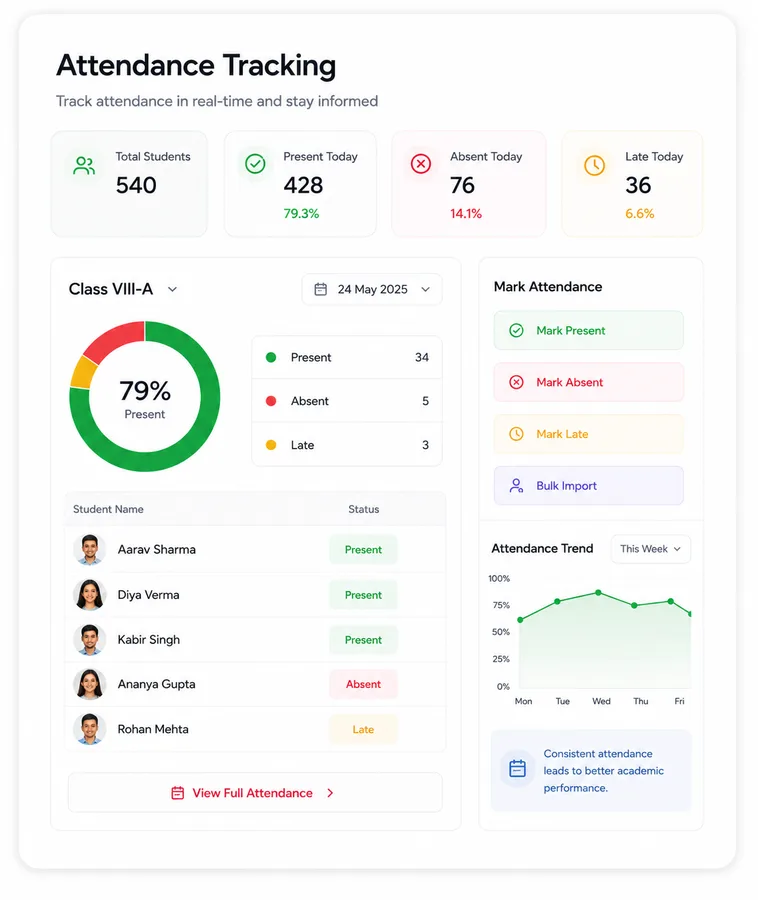
Campus 24x7 attendance dashboard showing 540 total students with 428 present, 76 absent and 36 late today, a class VIII-A breakdown at 79% present, a named student register with present, absent and late marks, and a weekly attendance trend
Present, absent and late for the day, one division opened at 79%, and the week's trend — with the register itself a tap away.

One thing to be clear about: parents cannot pay fees online through the app today. Payments are recorded by your office — cash, cheque, UPI, card, bank transfer or wallet, each with its reference number — and everything around that is automated: structures per division and campus, nightly invoicing, late fines, receipts and overdue reminders on WhatsApp. We would rather you know that now than discover it in a demo.

Where the term-end week goes

The same jobs, with the manual part removed

Relative effort for five term-end jobs, before and after the work is automated. Proportions, not a measured study — your own numbers will depend on your roll and how much is on paper today.

  • Manual process today
  • Effort remaining on Campus 24x7
Relative effort for five term-end jobs, manual process compared with Campus 24x7, where the manual process is one hundred per cent.
TaskManualOn Campus 24x7
Fee reconciliation100%25%
Marks consolidation100%20%
Report card assembly100%15%
Timetable clashes100%10%
Parent follow-up calls100%35%
Why scale changes the problem

What makes this harder in Mumbai and MMR

One of India's densest multi-board markets

Mumbai concentrates SSC, CBSE and ICSE schools in the same neighbourhoods, often in the same building. Each board carries its own assessment pattern, so the term-end work is not one set of marks but several, repeated every cycle.

Roll sizes that break manual process

Individual MMR campuses routinely carry 2,000 to 5,000 students across 40 or more divisions. At that volume a mis-keyed fee line or a missed absence is one of several thousand records that nobody can audit without a system.

Parents who already run their lives on a phone

A family commuting from Virar or Panvel is not going to visit the office to ask about an absence. School management software that reaches them where they are is now part of how a school is judged at admission time.

Records that must survive a state return

Maharashtra schools file UDISE+ returns and answer departmental queries that ask for history at short notice. Data held in one system can be filtered and exported on the day; data spread across cabinets and personal drives cannot.

Boards and languages

Three boards in one school, and three languages at home

The two things a Mumbai page has to answer honestly: whether the grading actually fits, and whether parents get the message in the language they read.

Grading that fits the division, not a template

  • Grading scales are configured per school and mapped per division
  • SSC, CBSE and ICSE divisions can run side by side in one school
  • Percentage bands, a 10-point CGPA or grades only — whichever your board needs
  • Theory, practical and internal marks are held and weighted separately
  • Section and class rank are calculated with the result

An example configured scale

SSC Maharashtra
GradePercentage rangePoints
A191 - 10010
A281 - 909
B171 - 808
B261 - 707
C151 - 606

An illustration of one scale a school might set up, not a scale we ship. Boards revise their patterns, which is exactly why the bands are yours to define rather than ours to hard-code.

Marathi, Hindi and English, side by side

  • WhatsApp templates are stored per institution, each with its own language
  • Marathi, Hindi and English versions of the same alert can run together
  • Absence alerts, fee receipts and exam results all use your approved templates
  • Messages go from your school's own WhatsApp number, not a shared gateway
How WhatsApp messaging works
The modules that carry it

What each part actually does

Four modules do most of the work in a large MMR school. Each links to its full detail page.

Fees

  • Term and instalment structures per division, per campus
  • Invoices generated nightly, with late fines applied by policy
  • Concessions and waivers recorded against the student
  • Receipts and overdue reminders delivered on WhatsApp
  • Payments recorded at the desk by mode and reference number
Explore fees

Attendance

  • Division registers marked on a phone in under a minute
  • Same-day absence alerts to the parent
  • Subject-wise and period-wise tracking, not just a daily mark
  • Shortage alerts against the 75% board eligibility threshold
  • Monthly register exported in one click
Explore attendance

Examinations

  • Grading scale set by the school — percentage bands, 10-point CGPA or grades
  • Theory, practical and internal marks held separately
  • Section and class rank calculated with the result
  • Three result card layouts to choose from, previewed before computing
  • Results published to the parent app when you are ready
Explore examinations

Timetable

  • Build the grid by hand or generate it from subject assignments
  • A save that would double-book a teacher or a room is refused
  • Conflict alerts and unassigned lectures counted on the dashboard
  • Room utilisation visible across the school
  • Parents and students see the timetable in the app
Explore timetable

On bus tracking: live location comes from the driver's phone running the Campus 24x7 driver app, so there is no GPS hardware to buy or fit to a bus. Transport is part of the Growth plan and above, not Foundation.

Before and after

The same office, running on one system

AreaOn paper and in spreadsheetsOn Campus 24x7
Multi-board recordsSeparate workbooks per board, with staff double-entering the same studentOne student record, with the grading scale mapped per division
Fee structuresRebuilt in a spreadsheet each term, campus copies drifting apartDefined once per division and campus, invoiced automatically each cycle
Fee follow-upPrinted slips sent home, with no record of who received oneScheduled overdue reminders on WhatsApp, with a delivery record
AttendancePaper registers reviewed at the term's end, if at allMarked on a phone, alerted the same day, totalled per term
TimetablingA whiteboard, and clashes discovered after the sheets are printedClashes refused at save time, with the conflicting slot named
Monsoon transportThe office switchboard becomes the tracking systemLive location from the driver's app, visible to office and parents
Branch transfersFiles couriered between campuses and re-keyed on arrivalOne record set, with role-based access per campus
State returnsWeeks of compiling spreadsheets from several registersAttendance and student data exported from one place
School shapes we fit

Three kinds of Mumbai school

High-enrolment suburban schools

  • Built for 2,000 to 5,000 students across 40 or more divisions
  • Registers for every division marked on a phone the same morning
  • Bulk marks entry and result cards for the whole standard
  • WhatsApp reaching the full parent body from one screen
  • Campus-level dashboards for Andheri, Borivali or Thane

SSC, CBSE and ICSE schools

  • A grading scale per division, so boards run side by side
  • Theory, practical and internal marks weighted as your board requires
  • Section and class rank calculated with the result
  • Attendance shortage alerts against the 75% eligibility threshold
  • UDISE+ compatible attendance export when the return is due

Multi-campus groups across MMR

  • Fee structures defined per campus, reported together
  • Role-based access so each principal sees their own campus
  • Student records that move with a child between campuses
  • One academic calendar, with campus-level variation where needed
  • Scale covers up to 2,500 students at ₹1,09,999 a year
Where we work

Schools across the Mumbai Metropolitan Region

The platform is cloud-based and onboarding is handled remotely, so a school in Vashi or Vasai is set up exactly as one in Dadar — no local installation, no on-site server.

  • Andheri
  • Borivali
  • Dadar
  • Bandra
  • Powai
  • Mulund
  • Chembur
  • Navi Mumbai
  • Vashi
  • Kharghar
  • Thane
  • Kalyan-Dombivli
  • Vasai-Virar
  • Panvel
What it costs

Priced by student strength

Annual billing shown. Monthly is available on each plan, and every plan includes two months free. Setup, data migration and staff training are part of onboarding, not a separate charge.

Foundation₹29,999 / year

Up to 500 students · 30 staff

Scale₹1,09,999 / year

Up to 2,500 students · 100 staff

Campuses above 2,500 students are quoted individually. See the full plan comparison.

The platform

What every Mumbai school gets on day one

  • Android apps for staff, parents and students
  • WhatsApp messaging from the school's own business number
  • Role-based access, down to the campus and the module
  • Data import and export, so records can be moved in and out
  • Audit logs on every plan, extended on the higher tiers
  • Setup, migration and training included, not charged as a project
Questions

What Mumbai schools ask us first

What does school management software cost for a Mumbai school?
Plans are priced by student strength. Foundation is ₹29,999 a year for up to 500 students, Growth is ₹49,999 a year for up to 1,000, and Scale is ₹1,09,999 a year for up to 2,500. Monthly billing is available on each. Larger campuses are quoted individually. Every plan includes two months free, and setup, data migration and staff training are part of onboarding rather than a separate charge.
Can parents pay school fees online through the app?
Not today. Fees are recorded by your office when a parent pays — by cash, cheque, UPI, card, bank transfer or wallet — and each entry carries its reference number. What the platform automates is the rest of the cycle: fee structures per division and campus, invoices generated nightly, late fines applied by policy, and receipts and overdue reminders sent to parents on WhatsApp. A parent-facing online payment option is not part of the product yet, and we would rather say so than let you find out during a demo.
Does it handle SSC Maharashtra, CBSE and ICSE in one school?
Yes. Grading scales are configured per school and mapped to a division, so divisions following different boards run side by side. You choose percentage bands, a 10-point CGPA or grades only, set a global passing percentage and override it per subject. Theory, practical and internal marks are held separately, and section and class rank are calculated with the result. The scales are yours to define — we do not ship a board template that has to match your school's practice.
Is this a school ERP or a school management system?
The same thing, under two names. Campus 24x7 is a cloud school management system covering admissions, the student information system, attendance, timetable, examinations, fees, transport, library, payroll and parent communication in one place. Schools that call it an ERP and schools that call it school management software are asking for the same set of modules, and this is that set.
Can we message parents in Marathi?
Yes. WhatsApp templates are stored per institution with their own language setting, so Marathi, Hindi and English versions of the same alert can run together and each family receives the one it reads. This covers the automated messages too — absence alerts, fee receipts, exam results and admission welcomes. Messages go from your school's own WhatsApp business number, so parents see the school's name rather than an unknown gateway.
How does school bus tracking work across Mumbai's routes?
Live location comes from the driver's phone running the Campus 24x7 driver app during the trip, so there is no GPS hardware to buy or fit to a bus. Routes and stops are defined per campus, children are marked boarded, alighted or absent at each stop, and transport fees are charged by route within the fee structure. Transport is part of the Growth plan and above, not Foundation.
Does it work for schools in Navi Mumbai, Thane and the wider MMR?
Yes. The platform is cloud-based, so a school in Vashi, Kharghar, Thane, Kalyan-Dombivli or Vasai-Virar is set up the same way as one in the city, and a group running campuses across MMR manages them from one place with role-based access per campus. Onboarding and training are handled remotely, so there is no dependency on a local installation or an on-site server.
How does the timetable handle multi-medium and multi-shift divisions?
You can build the grid by hand or let Campus 24x7 generate it from your subject assignments. Either way, every save is checked against the rest of the school: a slot that would double-book a teacher, put two divisions in one room or give a division two lessons at once is refused rather than saved. The dashboard counts conflict alerts and unassigned lectures and shows room utilisation, so clashes surface before the timetable is printed, not after.
What does the platform do about UDISE+ returns?
Attendance and student data can be exported in a UDISE+ compatible form, so the figures you need come out of one system rather than being compiled from several registers. To be precise about the limit: this is an export whose structure suits the return, not a direct submission integration — the filing itself is still done by your staff on the government portal.
How long does it take to move off our Excel setup?
Most schools are running inside two to three weeks. We import your existing student, staff and fee data from Excel, CSV or your previous system, set up your divisions, fee structures and grading scales, and train each department on the part it uses. Schools usually start with fees and attendance in the first week and bring on examinations, timetable and transport once the office is comfortable.
Ready to run your Mumbai school on one connected system?

If your office is still rebuilding mark sheets each term and finding timetable clashes after they are printed, a short demo will show you what changes. We will set it up against your boards, your mediums and your campuses, not a generic template.