SCHOOL ERP SOFTWARE IN DELHI NCR

School ERP software built for Delhi NCR's multi-board, multi-branch schools

A 3,000-student campus running CBSE and CISCE side by side has two grading patterns to rebuild every term, a fee desk that cannot close its books, and parents who hear about an absence a term late. Campus 24x7 lets you configure each board's grading scale once, invoice the whole roll on a schedule, and reach every family in Hindi or English — from your school's own WhatsApp number, on the day it matters.

Used by schools across IndiaCBSE, CISCE and state-pattern classesHindi and English parent alerts
The Delhi NCR reality

What actually breaks in a large NCR school

Not hypotheticals — the five things principals and office staff in Delhi describe when a term is about to close.

01

Fee desks that cannot keep up with the roll

A 3,000-student campus in Dwarka or Rohini runs thousands of fee lines a term. When structures live in spreadsheets and receipts are written at a counter, the office spends the first week of every term reconciling instead of closing.

02

Attendance nobody sees until the PTM

With 40 to 50 children in a section, a paper register is a record, not a signal. A pattern of Monday absences is obvious in a dashboard and invisible in a stack of registers — and the parent, commuting from Noida or Gurugram, hears about it a term late.

03

Three boards, three sets of rules

Delhi schools run CBSE, CISCE and Delhi state syllabi side by side, each with its own grading pattern and report card shape. Rebuilding those sheets in Excel every assessment cycle is where most of the term-end time goes.

04

Circulars that never reach the parent

A notice handed to a child is a notice you cannot prove was delivered. Parent WhatsApp groups fill with replies and the original message scrolls away. Nothing tells the office who actually saw the fee notice or the PTM date.

05

Branches that each keep their own version

A trust running campuses across Dwarka, Rohini and Greater Noida ends up with three fee structures, three attendance habits and three ways of naming a class — and no consolidated number until someone merges the sheets by hand.

How it runs

One thing happens, and the next one follows

Every line below is something the platform does today. Nothing here is on a roadmap.

  1. A child is marked absent in the register → the parent gets one WhatsApp alert that day, from the school's own number
  2. A fee invoice falls due → the overdue reminder goes out on your schedule, not when someone remembers
  3. The office records a payment at the desk → the receipt reaches the parent on WhatsApp and the ledger updates at once
  4. A teacher enters marks once → grades, totals and the report card come from the scale that class is mapped to
  5. A bus starts its run → the driver's app streams its location to the office and to waiting parents
  6. An exam result is published → every parent in that class is messaged, and the office can see who was reached
Inside the product

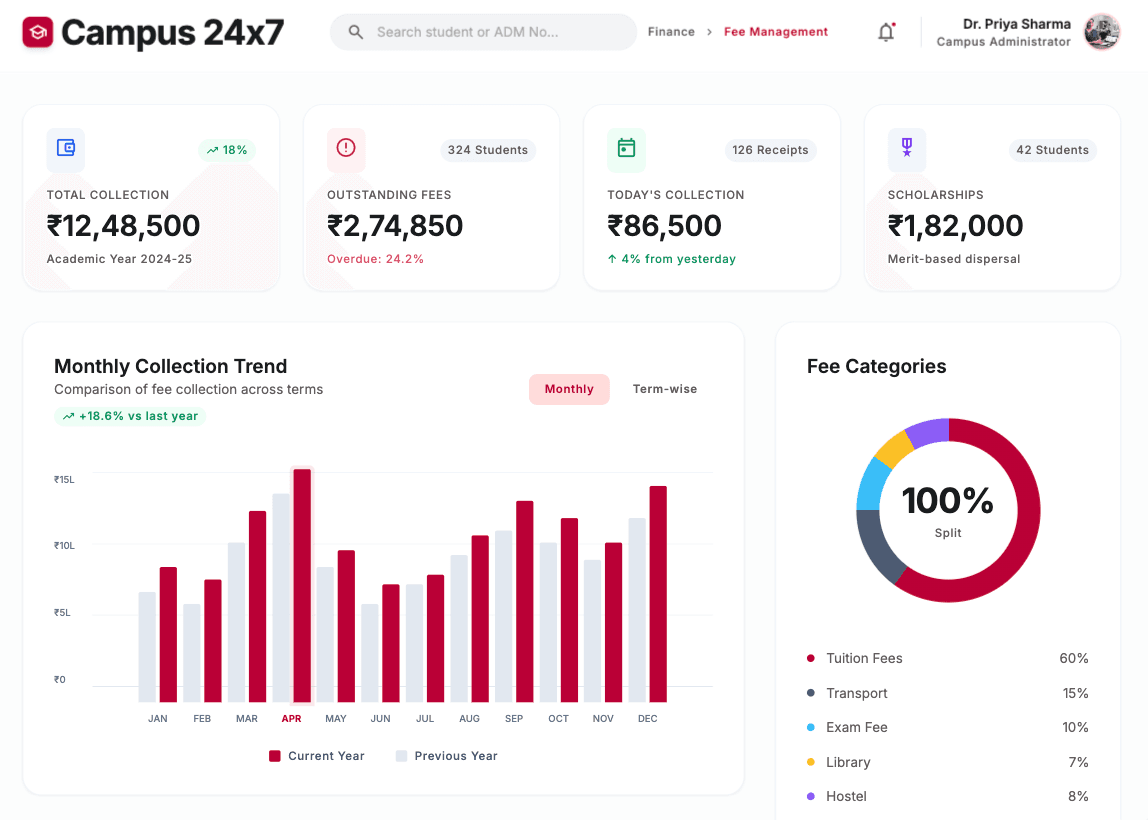
The fee desk, with the term's position in view

The reason a Dwarka or Rohini office loses the first week of a term is not that collecting fees is hard — it is that nobody can see where the term stands without rebuilding a sheet. Structures live in one file, receipts in a book, concessions in someone's memory.

Campus 24x7 holds the structure per class and per branch, generates invoices nightly, applies late fines by the policy you set, and records concessions against the student. The office records a payment at the desk by mode and reference, the receipt goes to the parent on WhatsApp, and the figure above updates as it happens.

Explore the fee management system
Campus 24x7 fee dashboard showing total collection, outstanding fees, today's collection and scholarships for the year, a month-by-month collection trend compared with last year, and a breakdown of fees by category
Collected against outstanding, this month set against last year, and where the money is coming from — one screen, no spreadsheet.

One thing to be clear about: parents cannot pay online through the app today. Payments are recorded by your office — cash, cheque, UPI, card, bank transfer or wallet, each with its reference number — and everything around that is automated: structures, nightly invoicing, late fines, receipts and overdue reminders. We would rather you know that now than discover it in a demo.

Where the term-end week goes

The same jobs, with the manual part removed

Relative effort for five term-end jobs, before and after the work is automated. Proportions, not a measured study — your own numbers will depend on your roll and how much is on paper today.

  • Manual process today
  • Effort remaining on Campus 24x7
Relative effort for five term-end jobs, manual process compared with Campus 24x7, where the manual process is one hundred per cent.
TaskManualOn Campus 24x7
Fee reconciliation100%25%
Marks consolidation100%20%
Report card assembly100%15%
Attendance totalling100%10%
Parent follow-up calls100%35%
Why scale changes the problem

What makes this harder in Delhi NCR

A multi-board city

Delhi NCR schools commonly run CBSE and CISCE together, and state-pattern classes alongside them. Each board carries its own grading scale and report format, so the work is not one set of marks but several, repeated every cycle.

Roll sizes that break manual process

Many NCR campuses carry 2,000 to 5,000 students. At that size a mis-keyed fee line or a missed absence is not a small error — it is one of several thousand records nobody can audit without a system.

Parents who expect to be told

NCR families already run their banking and their commute on a phone. A school still sending paper circulars is not just slower; it looks less organised than the one down the road that messages the same day.

Records that must survive an inspection

Affiliation reviews and departmental queries arrive with short notice and ask for history. Data that lives in one system can be filtered and exported on the day; data in cabinets and personal drives cannot.

Boards and languages

Three boards in one school, and two languages at home

The two things a Delhi page has to answer honestly: whether the grading actually fits, and whether parents get the message in the language they read.

Grading that fits the class, not a template

  • Grading scales are configured per school and mapped per class
  • CBSE, CISCE and state-pattern classes can run side by side in one school
  • Marks are entered once and carried into the report card by that scale
  • Report cards are generated from whichever scale the class is mapped to

An example configured scale

CBSE
GradePercentage rangePoints
A191 - 10010
A281 - 909
B171 - 808
B261 - 707
C151 - 606

An illustration of one scale a school might set up, not a scale we ship. CBSE's top band is partly positional, so cut-offs move year to year — which is exactly why the bands are yours to define.

Hindi and English, side by side

  • WhatsApp templates are stored per institution, each with its own language
  • Hindi and English versions of the same alert can run together
  • Absence alerts, fee receipts and exam results all use your approved templates
  • Messages go from your school's own WhatsApp number, not a shared gateway
How WhatsApp messaging works
The modules that carry it

What each part actually does

Four modules do most of the work in a large NCR school. Each links to its full detail page.

Fees

  • Term and instalment structures per class, per branch
  • Invoices generated nightly, with late fines applied by policy
  • Concessions and fine waivers recorded against the student, not in a margin
  • Receipts and overdue reminders delivered on WhatsApp
  • Payments recorded at the desk by mode and reference number
Explore fees

Attendance

  • Section registers marked on a phone in under a minute
  • Same-day absence alerts to the parent
  • Running percentages per student, per term
  • Patterns visible before the parent meeting, not after
Explore attendance

Examinations

  • Grading scales configured by the school, per class
  • Marks entered once and carried through to the report card
  • Report cards generated in bulk for the whole class
  • Results pushed to parents as soon as they are published
Explore examinations

Transport

  • Routes and stops defined per branch
  • Live location from the driver's app during the trip
  • Boarded, alighted and absent marks against each stop
  • Transport fees charged by route as part of the fee structure
Explore transport

On bus tracking: live location comes from the driver's phone running the Campus 24x7 driver app, so there is no GPS hardware to buy or fit to a bus. Transport is part of the Growth plan and above, not Foundation.

Before and after

The same office, running on one system

AreaOn paper and in spreadsheetsOn Campus 24x7
Fee structuresRebuilt in a spreadsheet each term, with branch copies drifting apartDefined once per class and branch, invoiced automatically each cycle
Fee follow-upPrinted slips sent home, with no record of who received oneScheduled overdue reminders on WhatsApp, with a delivery record
AttendancePaper registers reviewed at the term's end, if at allMarked on a phone, alerted the same day, totalled per term
Report cardsMarks collected from individual teachers and merged by handEntered once, calculated against the class's own grading scale
Parent noticesCirculars sent via schoolbag, or lost in a group chatSent from the school's number to every parent in the class
Branch oversightEach campus keeps its own sheets; group totals merged manuallyOne system across campuses, with role-based access per branch
Inspection requestsA scramble through cabinets and personal drivesFiltered and exported from one record set
School shapes we fit

Three kinds of NCR school

Large CBSE and CISCE campuses

  • Grading scales configured per board and mapped per class
  • Bulk marks entry and report card generation for the whole roll
  • Exam schedules published to parents as they are set
  • Student history kept in one record set for affiliation reviews
  • Parent access to attendance, results and fee status

Trusts running several NCR branches

  • Fee structures defined per branch, reported together
  • Role-based access so each principal sees their own campus
  • Student records that move with a child between branches
  • One academic calendar, with branch-level variation where needed
  • Consolidated view across campuses for the trust office

Smaller and budget private schools

  • Foundation covers up to 500 students at ₹29,999 a year
  • Setup, data migration and staff training handled by our team
  • Hindi parent messaging from day one
  • Start on fees and attendance, add transport on Growth when needed
  • Two months free while the school moves across
What it costs

Priced by student strength

Annual billing shown. Monthly is available on each plan, and every plan includes two months free. Setup, data migration and staff training are part of onboarding, not a separate charge.

Foundation₹29,999 / year

Up to 500 students · 30 staff

Scale₹1,09,999 / year

Up to 2,500 students · 100 staff

Campuses above 2,500 students are quoted individually. See the full plan comparison.

The platform

What every Delhi school gets on day one

  • Android apps for staff, parents and students
  • WhatsApp messaging from the school's own business number
  • Role-based access, down to the branch and the module
  • Data import and export, so records can be moved in and out
  • Audit logs on every plan, extended on the higher tiers
  • Setup, migration and training included, not charged as a project
Questions

What Delhi schools ask us first

What does Campus 24x7 cost for a Delhi school?
Plans are priced by student strength. Foundation is ₹29,999 a year for up to 500 students, Growth is ₹49,999 a year for up to 1,000, and Scale is ₹109,999 a year for up to 2,500. Monthly billing is available on each. Larger campuses are quoted individually. Every plan includes two months free, and setup, migration and training are part of onboarding rather than a separate fee.
Can parents pay fees online through the app?
Not today. Fees are recorded by your office when a parent pays — by cash, cheque, UPI, card, bank transfer or wallet — and each entry carries its reference number. What the platform automates around that is the rest of the cycle: fee structures per class and branch, invoices generated nightly, late fines applied by policy, and receipts and overdue reminders sent to parents on WhatsApp. A parent-facing online payment option is not part of the product yet, and we would rather say so than let you find out during a demo.
Does it handle CBSE, CISCE and state-pattern classes in one school?
Yes. Grading scales are configured per school and mapped to a class, so classes following different patterns can run side by side. Teachers enter marks once, and the report card is produced from whichever scale that class is mapped to. The scales are yours to define — we do not ship a board template that has to match your school's practice.
How does bus tracking work across Delhi's routes?
Live location comes from the driver's phone running the Campus 24x7 driver app during the trip, so there is no GPS hardware to buy or fit. Routes and stops are defined per branch, children are marked boarded, alighted or absent at each stop, and transport fees are charged by route within the fee structure. Transport is part of the Growth plan and above, not Foundation.
Can we message parents in Hindi?
Yes. WhatsApp templates are stored per institution with their own language setting, so Hindi and English versions of the same alert can run together and each family receives the one it reads. This covers the automated messages too — absence alerts, fee receipts, exam results and admission welcomes. Messages go from your school's own WhatsApp business number.
How long does it take to move off our current system?
Most schools are running inside two to three weeks. We import your existing student, staff and fee data from Excel, CSV or your previous system, set up your classes, fee structures and grading scales, and train each department on the part it uses. Schools usually start with fees and attendance in the first week and bring on examinations and transport once the office is comfortable.
Is our student data secure?
Data is held on Indian cloud infrastructure with encrypted connections, automated backups and role-based access, so a class teacher, a branch principal and the trust office each see only what their role allows. Audit logs record changes on every plan, with longer retention on the higher tiers.
Ready to run your Delhi NCR school on one connected system?

If your office is still rebuilding mark sheets each term and chasing fees by phone, a short demo will show you what changes. We will set it up against your boards, your branches and your fee structure, not a generic template.